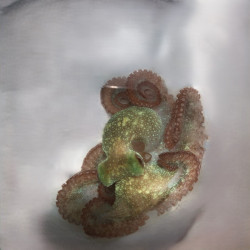
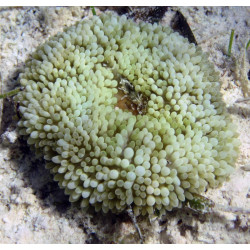
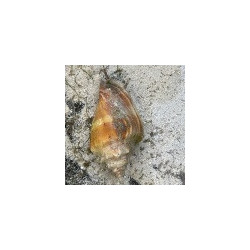
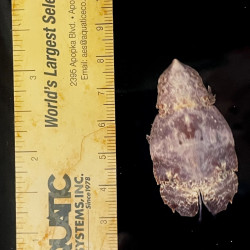
The Upside Down Jellyfish is a unique species often found lying bell-down on sandy or muddy seafloors, with its tentacles facing upwards. This posture allows its symbiotic algae to receive sunlight for photosynthesis, making it an iconic and unusual inhabitant of shallow tropical waters. Unlike typical jellyfish, it rarely swims freely and relies on its symbionts for energy.
Coloration:
-
Bell and tentacles are translucent with shades of brown, green, or tan.
-
The tentacles often have golden or green highlights due to the photosynthetic algae (zooxanthellae).
-
Some individuals display subtle purples or blues along the edges.
Typical Size and Abundance:
-
Average size: 4–6 inches (10–15 cm) in bell diameter
-
Maximum size: up to 8 inches (20 cm)
-
Abundance: Common in mangroves, shallow lagoons, and seagrass areas throughout the Caribbean and tropical Atlantic.
Behavior and Aggressiveness:
-
Non-aggressive.
-
Remains mostly stationary, pulsing gently to circulate water and bring in nutrients.
-
Can release mild stinging cells into water if disturbed, which may irritate small fish or humans.
Reproduction and Sexuality:
Toxicity:
Care Difficulty:
-
Moderate to challenging. Requires stable water parameters, calm water flow, moderate lighting for symbiotic algae, and nutrient-rich conditions. Handling should be minimal to prevent stress or stings.
Fun Facts:
-
Lies upside down to expose its symbiotic algae to sunlight for photosynthesis.
-
Produces “cassiosomes,” tiny stinging particles in its mucus that can paralyze small prey.
-
Unlike most jellyfish, it spends most of its life attached to the substrate.
-
Can form large clusters on shallow seafloors, creating a shimmering effect in sunlight.
-
Popular in aquariums for its unusual appearance and fascinating behavior.


 Delivery policy